Mathematics Department - Beliefs

Vision:

To be a value – added department that provides every Hendersonian with a good Mathematical foundation for lifelong learning.

Mission:

Through grounded practices and support, we develop resilient students with a problem-solving mind.

Wednesday, February 10, 2016

29 February


The year of 2016 is a leap year. This is characterised by a year with the existence of an extra day in February - 29th February. On normal years, the month of February ends on the 28th. As such, let's learn more about leap day and years so that you can share more about them with your friends and family, especially on 29 February itself!


When is a year a leap year?
if (year is not exactly divisible by 4) then (it is a common year)
else if (year is not exactly divisible by 100) then (it is a leap year)
else if (year is not exactly divisible by 400) then (it is a common year)
else (it is a leap year)
(Source: Wikipedia on Leap Year)

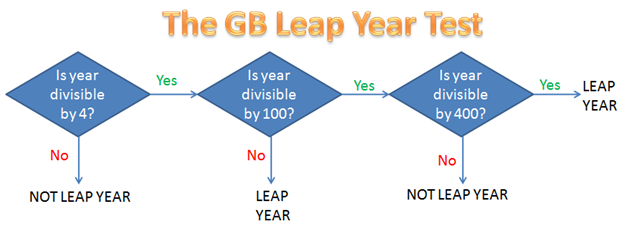
For those who understand better with a visual flow chart, use the following diagram instead to find out if a year is a leap year.


(Source: Mathandmultimedia.com)

What is the point of adding an extra day to the calendar?
The Earth takes around 365.25 days to orbit around the Sun, instead of what most of us know of 365 days. Due to the additional 0.25 days that the Earth takes to orbit around the Sun, an extra day is added into the calendar to make up for the days lost over the years. The reason it is done every 4 years is because 0.25 x 4 = 1 day.

Why must the leap day be added to the month of February?
We shall leave this question for you to do some self-exploration. What evidence we have found seems more like a myth than a fact. It has something to do with the Roman Emperor Caesar Augustus and his predecessor Julius.

Leap Year/Day Jokes and Quotes
We shall now end of the post with some leap year/day jokes/quotes! Have fun reading them and laughing out loud :)
- I can't believe it has only been four years since you told the same leap year jokes.
- I hope 25% of your wishes come true this leap-year-birthday.
- Remember to live everyday like it is a Leap Day.
- It's a leap year! Everyone's birthday after 29 Feb will be one day late.
- Happy Leap Day! A day where "this time last year" and "this time next year" does not apply.


Some of you might be wondering about another phenomenon known as the "leap second". For more information on that, do refer a post that we have written some time ago. Here's the link to it: Leap Second.

When the time comes, we hope that you will use this extra day to good use!

Tuesday, January 26, 2016

Mathematical Conundrums

Conundrums are known as problems that are difficult or confusing. One of the more widely known mathematical conundrum is whether 0.999... is equals to 1.  Below is an idea of it for those of you who do not know what it is about:

(Image from Wikipedia.)

Comparing the first and last sentences from the above, you see that 0.999... = 1. (Amazing!!)

There are many more mathematical conundrums that you can sprawl through on the internet. For now, we will just share with you two of the more easier to understand ones.

The first one
What is 1 + 2 + 4 + 6 + 8 + 16 + ...?

Here, the "..." means continuing to sum forever, adding twice as much each time. You would think that this sum must be infinite. Think again...

Let's multiply the sum above by 2. This will give us 2 x (1 + 2 + 4 + 6 + 8 + 16 + ...) = 2 + 4 + 6 + 8 + 16 + ... which looks a lot like the original sum with the 1 missing at the start.

This brings us to conclude that 2 x (1 + 2 + 4 + 6 + 8 + 16 + ...) is 1 less than (1 + 2 + 4 + 6 + 8 + 16 + ...). That is to say that

2 x (1 + 2 + 4 + 6 + 8 + 16 + ...) - 1 x (1 + 2 + 4 + 6 + 8 + 16 + ...) = -1.

Simplifying the left hand side will give us

1 + 2 + 4 + 6 + 8 + 16 + ... = -1.

How is it that adding bigger and bigger numbers can lead us to negativeland a.k.a negative one? Confused yet? If not, read on...

The second one
What is the value of the infinite sum 1 - 1 + 1 - 1 + 1 - 1 + ...?

If we add in brackets, we can observe that 

(1 - 1) + (1 - 1) + (1 - 1) + ... = 0 + 0 + 0 + ... 

which means that the value of the infinite sum is 0. 

Then again, if we express 1 - 1 + 1 as 1 - (1 - 1), then we can rewrite the infinite sum as 

1 - (1 - 1) - (1 - 1) - (1 - 1) ... = 1 - 0 - 0 ...

which means that the value of the infinite sum is 1.

So is it 0 or 1? Or 0 half the time and 1 the other half the time? You must be confused by now...

We shall end here to let your confused minds ponder over things. 

If you want to know more about the above two conundrums, you can read about the first conundrum here and the second conundrum here. Links open in a new windows.

Reference: Jordan J. Ellenberg, J. (2014). How Not To Be Wrong The Hidden Maths Of Everyday Life. Great Britain: Penguin. (Great book about mathematics by the way! Go read it!)

Friday, January 22, 2016

Just For Fun: Logic Games To Keep You Going!


To relieve you from the monotony of studying and working, the Maths Department is here to introduce you to some free to play online logic puzzles!

Why play logic puzzles?
Logic puzzles are fun! But more than that, playing logic puzzles will help with our deductive reasoning. That is important because we unknowingly use our deduction skills in our everyday lives! From "the service guy in front is a more experienced worker, so I will queue up in his line instead of the other line." to "it takes me one hour to reach Jurong Point, if I leave at 1700, I will reach by 1800." Making the better choice base on your deductive reasoning will help you infinitely :)

So here is the list of free to play logic puzzles that we have found. This is not an exhaustive list, so do comment down below if you have enjoyed any other online logic puzzles that you have found. We would love to hear from you!

Sudoku
Paint-By-Number
Futoshiki
Story Based Logic Puzzles
(The following links will open in a new window.)

The puzzles have varying levels of difficulty, all of which you can select when you are at the webpage itself. They can be done during your breaks to keep your brain going while doing something different from your studies or work.

Enjoy the games and may the odds be ever in your favour!

Saturday, September 26, 2015

Haze In Singapore: How Is PSI Calculated?

With the recent spike in PSI readings such that the MOE had to call for a closure of all Primary and Secondary Schools on 25 September 2015, have you ever wondered how the various agencies determine the PSI readings and levels?

In other words, how is PSI calculated?

The PSI is based on six pollutants particulate matter (PM10), fine particulate matter (PM2.5), sulphur dioxide (SO2), carbon monoxide (CO), ozone (O3) and nitrogen dioxide (NO2). For each pollutant, a sub-index is calculated from a segmented linear function that transforms ambient concentrations onto a scale extending from 0 through 500.

The breakpoints used in defining each of the six pollutant sub-indices are listed as follows:


Using the following equation:


Finally, the overall index is calculated as the maximum of sub-indices:

PSI = maximum (I1, I2, I3, I4, I5, I6)


To put it simply, here is an example of the PSI calculation.


So this is how PSI readings are computed by National Environment Agency. This is for those who are curious but nevertheless, we should all be aware and always take precautionary measures under such unpredictable hazy conditions. HEALTH IS WEALTH!


Source: http://www.haze.gov.sg/docs/default-source/faq/computation-of-the-pollutant-standards-index-(psi).pdf

Thursday, September 10, 2015

Designing with TI Graphing Calculator Competition - Results

The wait is finally over! Here are the results of the competition that we took part! (you may refer to our previous post on 15 July 2015)

After 2 months of intensive brainstorming and hard work, Henderson Secondary has done well in this competition.

We are pleased to announce that Henderson Secondary School has emerged 6th in the overall school standing (we achieved 7th placing in 2014) and 3 of our students achieved the Bronze Award for their design (2 Individual Bronze Awards in 2014)!

Here is the list of participants and their achievements.


No.
Name
Class
Award
1
JADON LIM CHOON ANN
3E2
BRONZE
2
JOVAN SALIM
3E2
BRONZE
3
DARREN ONG WEI KANG
3E2
BRONZE
4
LOW CHERMAINE
3E1
PARTICIPATION
5
CHAN KENG HUNG
3E1
PARTICIPATION
6
CHIAM SEN JAY
3E1
PARTICIPATION
7
ESTHER TAN MEI JING
3E2
PARTICIPATION
8
JERUSHA MERLIN
3E2
PARTICIPATION
9
TAN JING LI
3E2
PARTICIPATION
10
TAN WEN LIN
3E2
PARTICIPATION
11
YEE WAI MIN EUNICE
3E2
PARTICIPATION
12
YEO RUO TENG
3E2
PARTICIPATION
13
JOSHUA
3E2
PARTICIPATION
14
MOHAMED NIZAM KHAN B M Z K
3E2
PARTICIPATION
15
PARAMDEV SINGH S/O SOUKHDEV S
3E2
PARTICIPATION
16
QU JIANHAO
3E2
PARTICIPATION
17
TAN JUN HAO ALAN
3E2
PARTICIPATION
18
MO LIMING
3N1
PARTICIPATION
19
VICTOR TAN PAU THIAN
3N1
PARTICIPATION
20
YANG KUNHUA
3N1
PARTICIPATION

Students who achieved the Bronze award would receive a certificate and a TI-84 Plus C Silver Edition Graphing Calculator, while students who achieved the participation award would receive a certificate and a 4GB USB.

Henderson Secondary School would receive a TI product gift voucher worth $500.

This would not have been possible if not for the time, effort, and guidance by Mr Lim Kwang Liang and Ms Eunice Teo.

Well done, boys and girls! May do do even better next year!

Wednesday, August 5, 2015

Presenting Data using Inforgraphics

This year, our Mathematics department decided to do away with the normal paper-and-pen June holiday homework and embarked on an exciting project with the lower sec mathematics students: Creating an infographic! 

The theme was Paper Recycling for sec 1s and Conservation of Water for the sec 2s. Student are divided into groups and did a series of research and findings before they represented all their data on an infographic.

Mathematics is no longer limited to the textbooks and classrooms. Students saw how Mathematics can be applied anywhere and everywhere in their lives.

Here are some samples of work from the students.


Wednesday, July 15, 2015

Designing with TI Graphing Calculator Competition

A yearly competition that HSS Math Department have been taking part, the theme for this year's competition is "National Day".

With the launch of the new TI-84 Plus C Silver Edition colour graphing calculator, only coloured graphic designs were allowed for submission.

The judging criteria for this competition is based on originality, difficulty and suitability.

In a nutshell, with the use of TI Graphing Calculators, students will complete their design using relevant mathematical equations and pixel drawing (to touch up the picture).

Let's take a look at some of the entries submitted by our very own HSS students!

Darren Ong, 3E2

Jovan Salim, 3E2

Nizam, 3E2

Tan Jing Li, 3E2

Esther Tan, 3E2

Yang Kunhua, 3N1

These are just some of the many entries that we have submitted so let's look forward to some them emerging as winners in this competition!

Submission of entries have been closed and an award ceremony for the winners will be held on 12 August 2015, Wednesday at Hwa Chong Institution (College), Singapore. 

Wednesday, July 8, 2015

Leap Second: 07:59:60 on 1 July 2015

Were you aware that there was an “extra second” added on 1 July?  Probably not right? A second more or less is probably insignificant to most as it does not have much impact on people’s lives.

The phenomenon, called a “leap second”, takes place every few years, where an additional second is inserted to the atomic clock, or UTC (Coordinated Universal Time).

So why was there an extra second?

The speed of the Earth's rotation differs from day to day and year to year and in particular to this phenomenon, the Earth’s rotation is known to be slowing down due to factors such as the moon’s gravitational pull and earthquakes. Scientists introduced the atomic time scale in 1967, which is what the world's time system and UTC is based on. But due to irregularities of the Earth's rotation and the precision of the atomic time, a mismatch between both time scales will occur. An extra second has to be inserted when the difference between two time scales exceed 0.9 second.

Isn’t that amazing? But you would have thought how this phenomenon is a big issue and how it affects us right?

Well, during the last leap second on June 30, 2012, more than 400 Qantas flights were delayed when the airline's check-in system crashed, while websites such as Reddit, Mozilla and LinkedIn experienced glitches because the systems could not cope with the extra time. Companies who rely on sub-second precision such as stock markets, i.e. The Singapore Exchange (SGX), adjusted its system’s clock so that it runs 1 second ahead of the UTC.

As we all know, a leap year occurs every 4 years and an extra day is added to the month of February. For leap second, it occurs either on June 30 or December 31 and do not happen very often - about every 3 years.


Friday, June 26, 2015

Singapore TOTO


In the Singapore game of TOTO, 6 numbers plus one "additional" number are drawn at random from the numbers 1 to 49. In the Ordinary game, players spend $1 and they choose 6 numbers in the hope of becoming instant millionaires. The previous Singapore TOTO’s top prize was 12 million dollars!! Some of you might have had the following thoughts, “What’s the chance of winning the top prize?” “Isn’t it 50%? Win or don’t win!” Apparently it is more sophisticated than that. A prize pool is established at 54% of sales for a draw. Typically, $2.8 million dollars is "invested" in each game - and games are offered twice per week. This is quite a lot for a country of 5.5 million people right?


TOTO Odds
Now we know that the chance of winning TOTO is 1 in 54. What’s the chance of winning the grand prize?
 
Summary of the Prizes (Singapore Toto)
Grp
Prize Amount
Winning Numbers Matched
1
38% of prize pool (min $1 M)
6 numbers
2
8% of prize pool
5 numbers + additional number
3
5.5% of prize pool
5 numbers
4
3% of prize pool
4 numbers + additional number
5
$50 per winning combination
4 numbers
6
$25 per winning combination
3 numbers + additional number
7
$10 per winning combination
3 numbers

Some simple statistics allow you to know that the chance of winning is: 6/45×5/44×4/43×3/42×2/41×1/40=8,145,060
The chance of you winning the top prize is 1 in 8 million! Considering that the total population in Singapore is 5.47 million as of June 2014 and 17% of Singaporeans are millionaires, maybe… you should save the $1 and the chances you becoming a millionaire are higher. J

Tuesday, June 2, 2015

Singapore and ASEAN Schools Math Olympiad Results

This year, we have sent some students to represent Henderson Secondary School to take part in the Singapore and ASEAN Schools Math Olympiad (SASMO) under the guidance of Ms Yvonne Lee.

We are proud to announce that we have achieved 4 Gold, 6 Silver and 2 Bronze awards which is a marked improvement from the previous year. Below's the list of the awardees.

SCHOOL
NAME
CLASS
SCORE
AWARD
HENDERSON SECONDARY SCHOOL
SHAO SIZHE
Sec 2
48
GOLD AWARD
HENDERSON SECONDARY SCHOOL
JOVAN TEE
Sec 2
44
SILVER AWARD
HENDERSON SECONDARY SCHOOL
VINOD SIO SIVAKUMAR
Sec 2
43
SILVER AWARD
HENDERSON SECONDARY SCHOOL
VANESSA MILKA RUSLIM
Sec 2
40
SILVER AWARD
HENDERSON SECONDARY SCHOOL
CHOW JUN WEI
Sec 2
39
SILVER AWARD
HENDERSON SECONDARY SCHOOL
YBO HUI SHAN
Sec 2
39
SILVER AWARD
HENDERSON SECONDARY SCHOOL
FRANKLIN ELSIM PUTRA
Sec 3
58
GOLD AWARD
HENDERSON SECONDARY SCHOOL
HONG DAVIN
Sec 3
55
GOLD AWARD
HENDERSON SECONDARY SCHOOL
QU JAINHAO
Sec 3
53
GOLD AWARD
HENDERSON SECONDARY SCHOOL
MO LIMING
Sec 3
47
SILVER AWARD
HENDERSON SECONDARY SCHOOL
ALEXANDER JEREMIA
Sec 3
37
BRONZE AWARD
HENDERSON SECONDARY SCHOOL
JANG KUNHUA
Sec 3
35
BRONZE AWARD

Here’s a little refresher on what is SASMO all about. SASMO is a Math Olympiad contest that stretches not only the brightest students but is aimed at instilling confidence for all students.

The contest is designed in a way to make every student love Math again. Our Math Olympiad Contest fits nicely into the school curriculum with a high focus on non-routine problem sums – preparing for our contests helps students prepare for the PSLE. It is an internationally recognized programme – in countries such as USA, Australia, New Zealand, India, Columbia, Iceland and many other countries around the globe.

Every year, the Gold Awardees are invited to represent Singapore in the Asia International Math Olympiad contest. This year, the Gold Award winners are invited to the Asia International Math Olympiad contest 2015 Finals in Bangkok,
Thailand.